The Schema-First Mental Model
On the previous page we described the problem: a schema layer that exists in every organisation but is governed by nobody, invisible below the OpenAPI surface, duplicated across teams, and never treated as shared infrastructure. The solution is not a new process or a new tool. It is a change in how you think about schemas.
Schemas are code. They define the structure and meaning of your data, determine what is valid and what is not, and represent the contracts that every API in your organisation either honours or violates. They deserve the same discipline you apply to any other critical piece of code: version control, review, and a single authoritative source.
The architecture in a nutshell
- A single Git repository holds your organisation's canonical schemas
- A registry sits on top of that repository and exposes its contents over HTTP: searchable, browsable, and queryable by any tooling or pipeline that needs it
- Changes go through Git, the same pull request workflow your organisation already uses for everything else
- Consumers reference schemas either directly via
$refpointing at the registry, or by runningjsonschema installto pull schemas into their own repository and reference them locally - API teams keep their OpenAPI specs wherever makes sense for them, pointing their schema references at the central source
That is the entire model. Everything that follows is grounded on those steps.
This model is already proven in practice
Maintaining a Git repository of schemas and serving it over HTTP is not a novel proposal. Most organisations doing it are closed-source, but several public examples are instructive.
SchemaStore is the most visible instance: a Git repository of JSON Schemas for popular tools, maintained through pull requests and served over HTTP. When your editor autocompletes a GitHub Actions workflow or a Kubernetes manifest, it is reading from a schema reviewed and merged through a PR there.
KrakenD maintains its configuration schemas the same way. So does NASA's General Coordinates Network for astronomical alert schemas, and the Human Cell Atlas for biological metadata.
At the public-sector level, the schema layer is already load-bearing infrastructure. JSON Schema underpins G7 governments across digital identity (the EU's mandatory EUDI Wallet), national health records, scientific data exchange, and compliance frameworks like NIST.
Ikenna Nwaiwu's Automating API Delivery: APIOps with OpenAPI (Manning, 2024) formalises the same approach for API definitions. This guide extends that thinking one layer deeper, to the schema layer those definitions depend on.
Enterprise organisations are already adopting this exact workflow for OpenAPI specifications. Afosto maintains OpenAPI definitions in per-service Git repositories, "committed to a central repository during the CI process," which "triggers a new gateway build." Medibank adopted contract-first development where "API endpoints, data structures, request/response formats" are defined and reviewed before implementation. Paymenttools routes every API change through Git, where it gets "automatically validated" against "PCI and ISO compliance" rules. These organisations have proven the GitOps model works for API specifications. Extending it one layer deeper, to the schemas inside those specifications, is the natural next step.
Fran Méndez, creator of AsyncAPI, arrives at the same architecture from the event-driven side in Shift: The Playbook for Event-Driven Architecture Advocacy (2026). The chapter Strategy 12, "Implementing Incremental Schema Governance," prescribes a central Git repository of contracts, CI-enforced validation, federated review via pull requests, and a human-friendly event catalog on top. The pattern is the same whether the contracts are JSON Schemas powering REST APIs or AsyncAPI files powering event streams. This convergence is no accident: REST contracts, event contracts, and message payloads all bottom out at the same schema layer, so governing the shape of the data once governs it across every protocol.
That convergence is visible in the specifications themselves. Analysing the published schemas of the nine standards that define the modern API landscape, API Evangelist mapped how each one references the others. OpenAPI, AsyncAPI, and Arazzo embed JSON Schema. MCP embeds it too. Spectral lints it. Almost every arrow eventually lands in the same place:
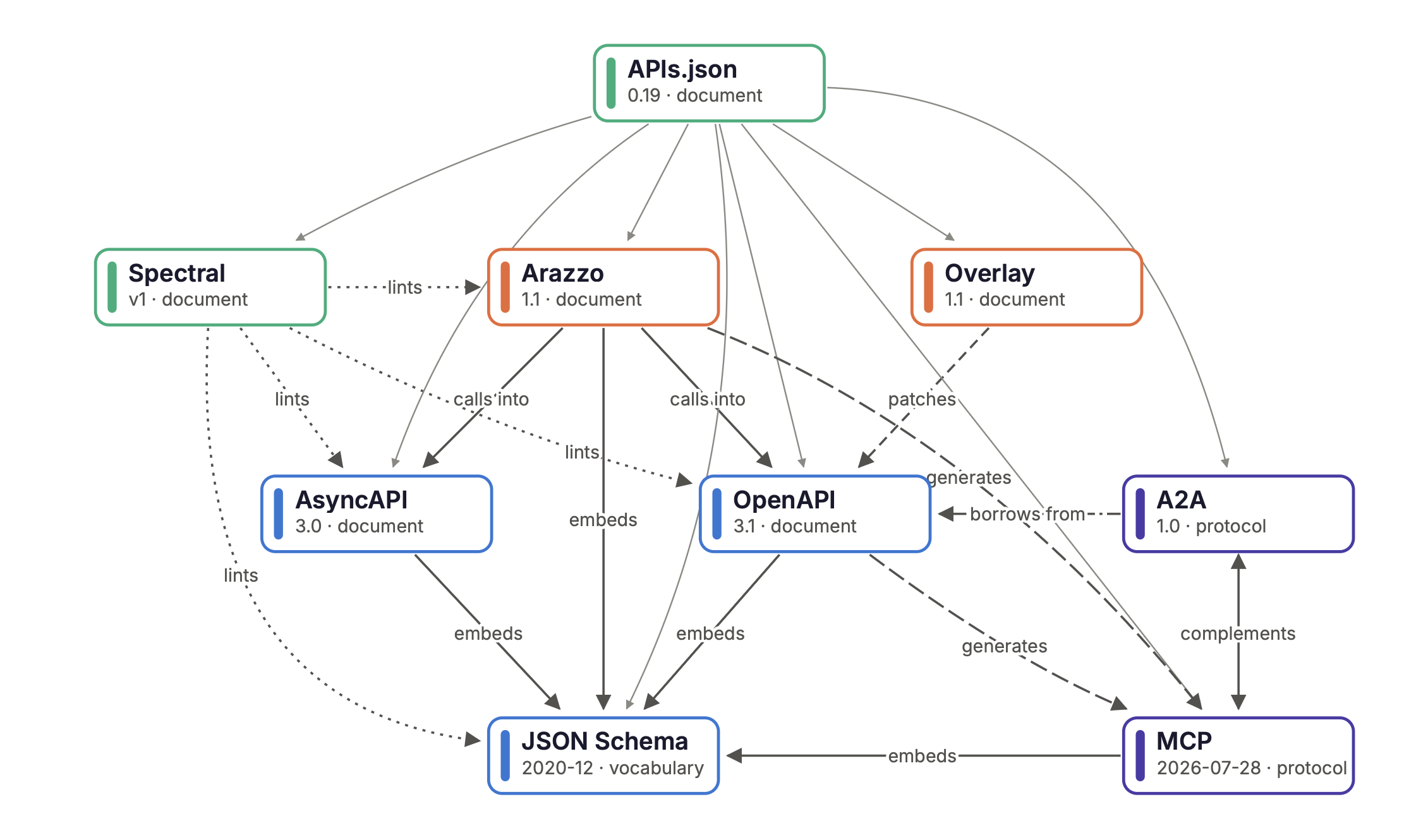
Diagram from How the Specifications Relate by Kin Lane, API Evangelist.
In Crafting Great APIs with Domain-Driven Design (Apress, 2025), Annegret Junker and Fabrizio Lazzaretti also advocate for APIOps as a practice that brings API design, implementation, and operation closer to each other, doing for APIs what DevOps does for code. At its core, the process is rooted in storing API definitions and their declarative configurations in a central version-controlled repository, and reconciling the desired state of the API against it.
Why Git? Governance by construction
This approach is a direct application of GitOps: using Git as the single source of truth for system state, where every change goes through a version-controlled, reviewable workflow.
In comparison, a stateful registry like Apicurio or Confluent accepts writes directly to itself over its API. This means that schemas can enter your canonical layer outside any review workflow. Some solutions bolt approval flows on top, but in doing so they are rebuilding what Git already provides natively: audit history, access controls, branch-based proposals, CI integration. They are rebuilding those capabilities with less maturity, less flexibility, and less familiarity than infrastructure your engineers have used for years.
Note
It is worth noting that stateful registries are the right tool for certain problems. In event streaming architectures, sharing a schema out-of-band for deserialisation is a coordination problem, and a stateful push model fits. API governance is a different problem.
With a Git-native approach, the registry has no write path. The only way to change what it serves is to change what is in Git, which means going through a pull request: proposable, reviewable, reversible, audited by default. Governance is not a policy people follow. It is a structural property of the system.
Git's extensibility compounds this advantage. You can attach anything to the workflow: AI reviewers, webhooks to notify downstream systems, automated duplicate detection, Slack notifications. The entire CI ecosystem the industry has built around Git works here without additional integration. No schema registry plugin system required.
Why a registry on top of Git, and not just Git
A raw file tree is not enough for everyone who needs to interact with the
schema layer. A product manager should not need a terminal and a git client to
understand what a Transaction schema contains. A governance team needs a
health view across hundreds of definitions, not file diffs. A pipeline
resolving a $ref will
prefer a stable HTTP endpoint, not a repository clone. A compliance stakeholder
needs rendered documentation, not raw JSON.
A read-only registry, like Sourcemeta One, turns the source of truth into something the whole organisation can use, without changing what the source of truth is. The registry is the interface. Git is the authority.
Because the registry holds no state, its operational profile is fundamentally simpler: no database, no sync process, no stateful service. A stateless registry is a single container, trivial to deploy and scale horizontally. Reliability increases precisely because the most common source of failure in distributed systems, stateful persistence, has been removed.
$ref versus jsonschema install
Referencing schemas via
$ref is convenient for
tooling, OpenAPI authoring, and local development. The tradeoff is a runtime
dependency on the registry being available, which is fine for most internal
workflows but a risk for production systems or airgapped environments.
The jsonschema
install
command fetches schemas with integrity verification and writes them to disk,
where they can be committed and used with no network dependency. The pattern is
identical to npm: you depend on the local copy, not the registry being live.
Many teams use $ref
during development and jsonschema
install
for production builds and CI.
One source of truth, but never a blocker
A source of truth requires one place, because two authoritative repositories means teams must choose, and that choice is where inconsistency begins. But the path there runs through local iteration, not around it.
A common fear about centralised governance is that it becomes a bottleneck. That is a misunderstanding of what this model is trying to achieve.
The goal is not to gate development behind a registry. It is to centralise and make official what teams are already building, in parallel, without ever blocking them. Local schemas are a staging area. If the registry does not have what you need, define it locally, ship, and keep building. Upstream proposals happen as a separate concern.
What the flow looks like
A developer on the payments team needs a PaymentMethod definition. The
registry does not have one. They define it locally, reference it from their
OpenAPI spec, and ship. Development is not blocked.
When the PR lands, the platform team notices the currency field uses a
freeform string where ISO
4217 already defines a
controlled vocabulary, and suggests internally referencing it. The schema
becomes stronger through review. The PR merges, triggering a CI action that
redeploys Sourcemeta One. On startup the registry reads from the updated
repository and PaymentMethod is now available canonically.
The payments team replaces their local definition with a
$ref to the registry.
The next team finds it through the registry and skips defining their own. A
third team runs jsonschema
install
to pull it locally. The local schema served its purpose and is gone.
Note
In some organisations the developer then proposes it upstream directly. In larger organisations, an API platform team continuously monitors what schemas are being defined locally across teams, identifies patterns worth standardising, and drives centralisation over time, replacing local definitions with canonical ones as adoption spreads. Either way, the schema moves upstream without blocking anyone.
The fragmentation cycle is always governed and prevented.